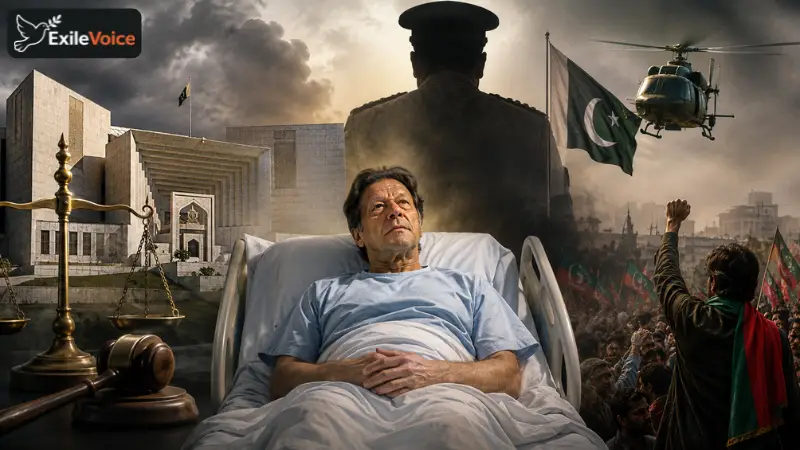
The recent directive from Pakistan’s Supreme Court ordering the transfer of former Prime Minister Imran Khan to a hospital marks a significant turning point in the nation's volatile political landscape. For observers and analysts, this development raises fundamental questions about the shifting balance of power between the judiciary, the political opposition, and the military establishment.
At the heart of this transition is the inquiry into whether this move represents a calculated strategic maneuver by the "hard state" or a genuine concession under pressure. Historically, the relationship between Pakistan’s military establishment and populist leaders has been defined by periods of intense friction and occasional forced cooperation. The decision to move Khan from incarceration to a medical facility, ostensibly for health reasons, is being parsed by international and local observers as a potential pivot point.
The primary question remains: Why grant relief now? From one perspective, the state may be attempting to alleviate domestic and international pressure that has mounted throughout Khan’s detention. By de-escalating the immediate crisis surrounding his health, the government may be seeking to stabilize a volatile public sentiment that threatens broader civil order. Alternatively, critics and political strategists suggest this could be a "trap" designed to lower the temperature of the Pakistan Tehreek-e-Insaf (PTI) movement while the state consolidates its position.
The Supreme Court’s intervention underscores the judiciary's role as a mediating force in Pakistan’s governance. As the government weighs its next move, whether to challenge or comply with the spirit of the court's order, the outcome will serve as a bellwether for the independence of institutional processes in the country.
Furthermore, the international media’s coverage of these events highlights the global significance of Pakistan’s political stability. Investors and regional neighbors are closely monitoring how the state handles the PTI leader, as his status directly impacts the nation's foreign policy leverage and domestic economic outlook. Whether this move signals a "blink" by the hard state or a tactical repositioning, it is clear that the political future of Pakistan remains deeply intertwined with the fate of its most prominent opposition figure.
As the situation evolves, the focus will likely remain on whether this administrative decision leads to a broader political dialogue or serves merely as a temporary measure to manage the ongoing unrest.