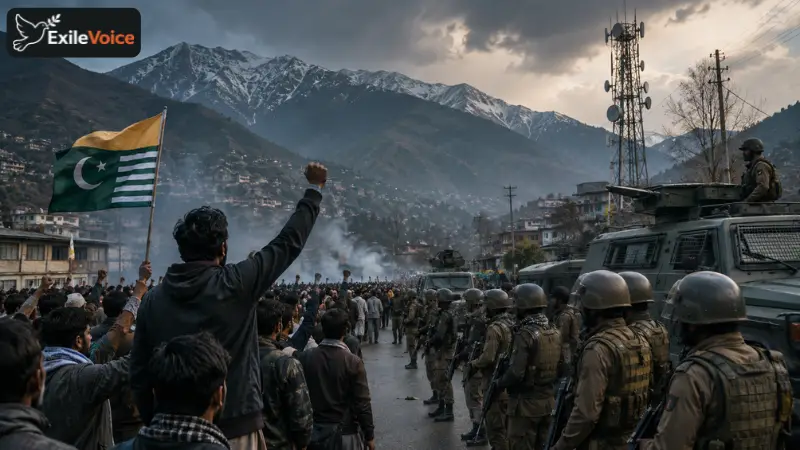
Azad Jammu and Kashmir is reportedly on the verge of a sweeping political and administrative crackdown aimed at stifling mounting public dissent. Sources close to the developments indicate that high-ranking military and administrative officials, including Brigadier Faiq, have finalized a strategy to aggressively neutralize the growing influence of the Kashmir Action Committee. This anticipated operations framework mirrors previous heavy-handed crackdowns observed across other political spheres in Pakistan, specifically focusing on the detention of key leadership figures and the preemptive dismantling of protest infrastructure.
To ensure the execution of this strategy without the risk of widespread public mobilization or real-time media coverage, plans have been set in motion to enforce a comprehensive shutdown of mobile networks and internet services across the region. This digital blackout serves a dual purpose: it cripples the organizational capabilities of the Action Committee and creates an information vacuum, obscuring the ground realities from national and international observers. The timing of this severe administrative intervention coincides directly with the official announcement of the Azad Kashmir Legislative Assembly general elections, which are formally scheduled for July 27, 2026. The electoral timeline mandates that candidates submit their nomination papers between June 9 and June 19, making the current window highly sensitive for political engineering.
The core of the unrest stems from a protracted dispute between the local populace, organized under the Kashmir Action Committee, and the ruling administrative apparatus. The Committee has consistently demanded far-reaching governance reforms, specifically targeting improvements in fundamental health and education infrastructure. Crucially, they are advocating for the abolition of the 12 legislative seats historically reserved for Kashmiri refugees residing in various parts of Pakistan. Local activists argue that these seats distort local representation, asserting that only full-time, permanent residents of Kashmir should possess the right to contest and determine the legislative outcome within the region.
A previous wave of demonstrations led to violent confrontations, resulting in casualties and subsequent state-led negotiations. While an agreement was formally signed promising to address the Committee's 12-point agenda, local leaders claim the government has systematically reneged on every major commitment. With elections fast approaching, the revival of the protest call has prompted state authorities to brand the Action Committee as anti-state entities intent on spreading anarchy.
Analysts warn that opting for a brutal kinetic crackdown instead of political dialogue carries immense geopolitical risks. Given the geographical and political sensitivities of Kashmir and nearby Gilgit-Baltistan, any domestic instability provides a strategic vulnerability that regional adversaries, particularly India, are poised to exploit. Heavy-handed internal security operations risk deeply alienating the local population, turning socio-economic grievances into an unmanageable constitutional crisis.