The current discourse surrounding the legal handling of a high-profile case involving allegations of gang rape underscores a long-standing grievance within Pakistan’s justice system: the perceived disparity in the application of law between the powerful and the disenfranchised. The case, involving associates of a prominent political figure, has brought to the forefront intense scrutiny of police conduct, judicial processes, and the influence of political patronage on legal outcomes.
At the heart of the matter is an First Information Report (FIR) detailing grave allegations against four individuals. The legal proceedings, which saw these individuals presented before a magistrate and subsequently remanded, have been accompanied by a controversial narrative being pushed by law enforcement authorities. While initial reports and the nature of the allegations strongly suggest a criminal act of severe proportions, the police have attempted to reframe the incident through the lens of a financial or 'crypto-currency' dispute.
This attempt to characterize a violent, predatory act as a commercial disagreement is seen by many analysts as a deliberate maneuver to dilute the seriousness of the charges and protect the accused due to their political connections. In any functional justice system, the nature of a crime, particularly one involving sexual assault, should remain separate from the alleged motive, be it financial or personal. The systemic failure to treat this case with the urgency and severity it demands points to a disturbing reality where political association can effectively act as a shield against the full force of the law.
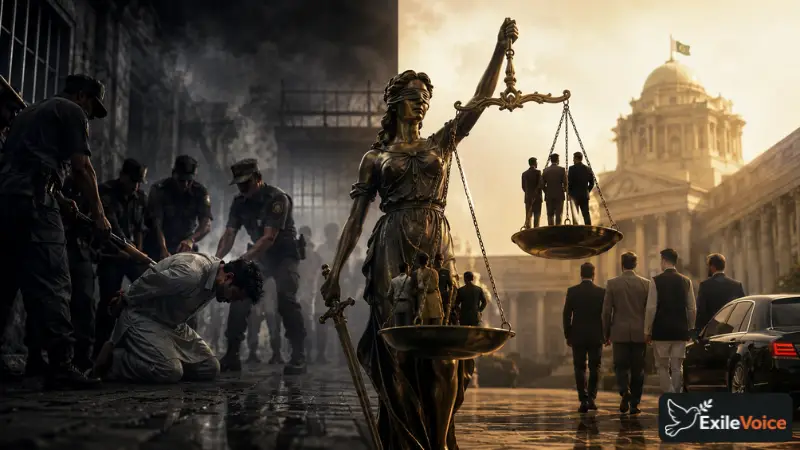
The broader public perception, fueled by historical instances of police brutality, such as the controversial use of force in encounters, contrasts sharply with the current handling of these high-profile suspects. When the accused are perceived as 'powerful' or connected to the ruling elite, the machinery of justice appears to undergo a transformation. Police procedures that might result in immediate and drastic measures against an ordinary citizen seem to be tempered, redirected, or slowed down when those at the top of the social or political hierarchy are involved.
This disparity does not only erode public trust in the police force; it undermines the very foundation of the rule of law. If the legal system is perceived to be malleable based on the status of the accused, the concept of equality before the law becomes a hollow promise. Analysts and critics have pointed out that the influence of political figures, such as senior ministers, in facilitating the legal or logistical aspects of such cases, further complicates the pursuit of justice.
The incident has also highlighted the internal pressures within the journalistic community and the legal apparatus itself. Independent voices are questioning why certain FIRs are 'allowed' to be registered only under extreme public pressure, rather than as a routine function of law enforcement. The silence or cautious maneuvering by those in positions of power, when confronted with the misconduct of their associates, serves only to deepen the crisis of credibility.
Ultimately, the integrity of a nation is measured by its capacity to hold all citizens accountable, regardless of their position. For Pakistan, the road to a more equitable society requires dismantling the culture of impunity that protects the powerful. It is a fundamental challenge that demands not only judicial reform but also a profound cultural shift in how political patronage is viewed and penalized. Without such a shift, the law will continue to be seen as a tool for the privileged, rather than a safeguard for all.