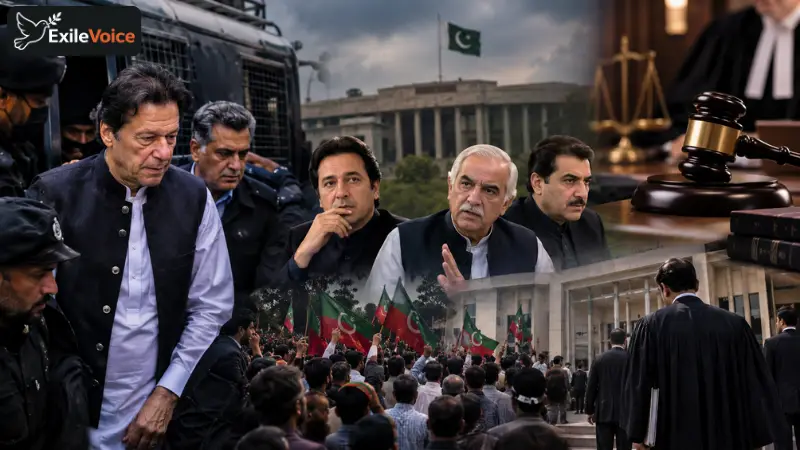
The legal landscape in Pakistan has reached a critical juncture, as the recent proceedings in the Islamabad High Court (IHC) regarding former Prime Minister Imran Khan and his spouse, Bushra Bibi, reveal a troubling pattern of judicial maneuvering. At the heart of the matter is the suspension of sentences, a legal provision that has historically been granted to political figures, including Nawaz Sharif and Maryam Nawaz, prior to the hearing of their main appeals. However, for Imran Khan, the rules appear to have been rewritten, signaling a departure from established legal norms and a move toward what many analysts describe as a "blueprint" for indefinite detention.
Legal experts point out that the standard procedure dictates that when a convict files for a suspension of sentence, it should be heard promptly. If the main appeal is taken up, the request for suspension usually becomes infructuous. In Khan’s case, the Islamabad High Court delayed the suspension hearings for an extended period. When the matter finally surfaced, the National Accountability Bureau (NAB) abruptly announced its readiness to argue the main appeal, effectively bypassing the possibility of Khan’s temporary release. This tactical shift, seemingly coordinated with the court, ensures that the PTI founder remains behind bars while the main appeal, likely to be dismissed given the current judicial climate, is processed.
The situation is further complicated by the 27th Constitutional Amendment and the establishment of a parallel "Constitutional Court." This new judicial tier is perceived by critics as a curated body designed to handle sensitive political cases, specifically to block Imran Khan's path to the Supreme Court. The fear is that any unfavorable verdict from the IHC will be appealed not to the traditional Supreme Court, but to this new entity, where judges are purportedly selected based on their alignment with the establishment's interests.
This systemic entrenchment raises a fundamental question for the Pakistan Tehreek-e-Insaaf (PTI) and the legal fraternity: is there any utility in engaging with a system that appears rigged? The notion of a total judicial boycott is gaining traction among radical circles. Proponents argue that by presenting arguments before benches that have already seemingly decided the outcome, lawyers inadvertently legitimize a compromised process. Instead, some suggest that legal battles should be taken to the "court of the people," where evidence and arguments are presented publicly to highlight the disparity between law and its application.
Furthermore, internal friction within the opposition ranks adds another layer of complexity. Reports suggest that key figures like Mahmood Khan Achakzai may be pursuing a dual-track strategy, publicly supporting Khan while privately negotiating with the Speaker of the Assembly for administrative perks and job quotas for their own constituents. If true, this indicates that the movement for Khan's release is being undermined from within by traditional patronage politics. The struggle for Imran Khan’s freedom is no longer just a courtroom battle; it is a fight against a sophisticated legal and political architecture designed to ensure his permanent exclusion from the Pakistani political arena.