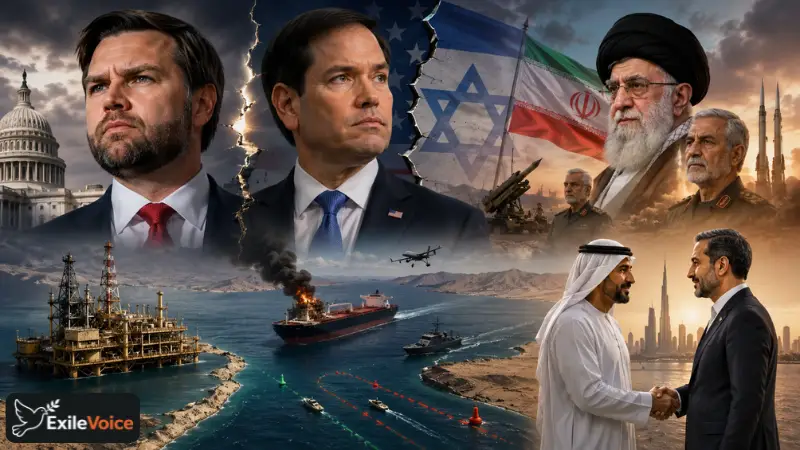
Recent developments in Washington suggest a notable divergence in foreign policy strategy within the U.S. administration, particularly concerning the Middle East. Analysis indicates that Vice President JD Vance and Secretary of State Marco Rubio are taking increasingly distinct positions on key regional issues, including Iran and the broader Middle East strategy. This internal policy dissonance is being closely monitored by observers and international media outlets, suggesting that the ideological lines for future presidential campaigns are already being drawn.
Secretary of State Marco Rubio appears to be increasingly aligning himself with Zionist forces, a strategic shift that reflects the evolving nature of political alliances within the Republican party. Conversely, Vice President Vance has maintained a different perspective, emphasizing nuances in diplomatic engagement and the interpretation of existing agreements, such as the 14-point Memorandum of Understanding (MoU) regarding Iran.
The situation is further complicated by the security landscape in the Persian Gulf. Following a drone strike on the oil tanker Ever Lovely, an incident Iran has denied responsibility for, the U.S. responded with military action against Iranian coastal assets. However, the core of the conflict revolves around the "safe passage" and "toll" mechanisms in the Strait of Hormuz. While the MoU ostensibly outlines a framework for navigation and toll collection, the practical implementation is currently being undermined by competing interests. Oman’s decision to open a southern passage, prompted by U.S. pressure, has further inflamed tensions with Tehran, which seeks to assert control over northern passage routes.
Furthermore, the recent engagement between the UAE Foreign Minister and his Iranian counterpart marks a significant diplomatic development. It signals that regional actors, while maintaining security partnerships with the U.S., are increasingly seeking autonomous diplomatic channels to address maritime security, reflecting a broader trend of regional countries hedging their bets and prioritizing local stability over absolute alignment with U.S. policy.