The current state of international diplomacy is witnessing a profound shift, particularly concerning the relationship between the United States and Iran. Recent public addresses by President Donald Trump have raised significant concerns among strategic analysts and the global community. The President's 19-minute speech, intended to reassure the American public and clarify the rationale behind recent military actions, appears to have had the opposite effect, fueling market volatility and geopolitical anxiety.
A critical point of analysis is the perceived "trust deficit" that has developed between Washington and Tehran. Observers note that the administration's oscillating approach, initiating military strikes followed by calls for ceasefires and negotiations, has created a psychological stalemate. From the Iranian perspective, the commitment to any diplomatic agreement is now viewed with extreme skepticism. This lack of trust is not merely a diplomatic hurdle; it is a fundamental barrier that renders ongoing communications, including those mediated by regional partners like Pakistan, increasingly ineffective.
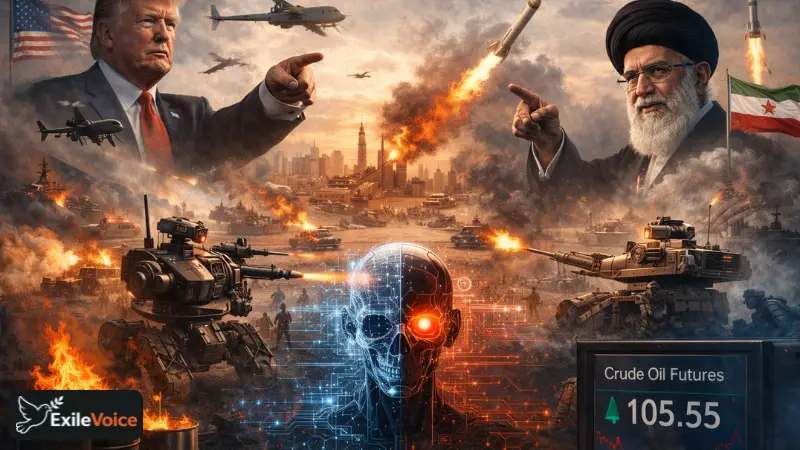
The strategic dimensions of this conflict are further complicated by the use of advanced technology. Iran is currently the primary theater for the implementation of sophisticated AI-driven military models. These systems, originally developed with larger global competitors in mind, are now being deployed in a high-stakes environment. This technological escalation marks a new era of "attrition warfare," where the human and economic costs are magnified by the precision and scale of autonomous systems.
Furthermore, the President's recent remarks regarding NATO and European allies suggest a fragmented Western front. While praising certain Gulf Cooperation Council (GCC) nations for their support, the administration has expressed disappointment with traditional European partners. This divergence in strategy not only weakens the collective security framework but also emboldens regional actors to pursue independent agendas. The economic fallout is already visible, with global oil prices surging and stock markets showing increased sensitivity to every administrative pronouncement.
The path forward remains obscured by these contradictions. For a diplomatic resolution to be viable, there must be a restoration of at least a baseline level of predictability in international conduct. Without clear strategic direction and a unified allied front, the risk of a protracted and unpredictable conflict continues to grow, posing a significant threat to global stability and the international economic order.