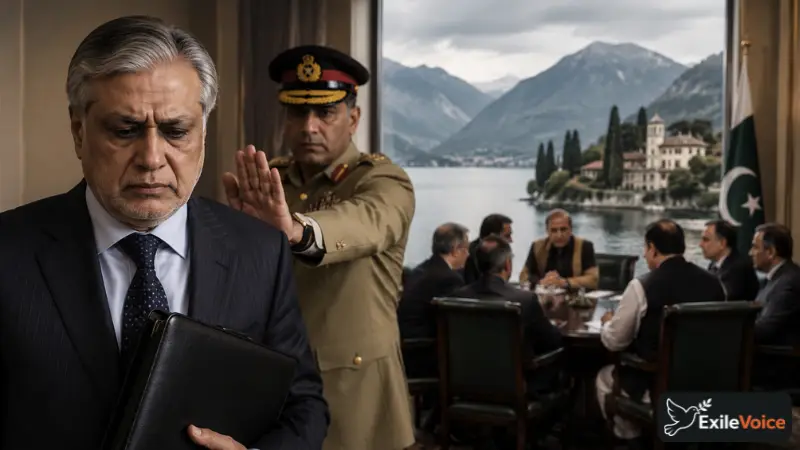
The recent diplomatic developments involving Pakistan’s Foreign Minister, Ishaq Dar, have surfaced internal fractures within the ruling establishment. During the high-stakes US-Iran negotiations held at Lake Lucerne, Switzerland, a venue owned by the Qatari royal family, Ishaq Dar attempted to make an appearance, reportedly cutting short a planned ministerial meeting in Egypt to do so. However, he was reportedly blocked from traveling to Switzerland by the current power structure, including orders channeled through the Prime Minister’s office.
Sources suggest that the decision to sideline Dar was driven by the military establishment’s direct control over the diplomatic process. This incident highlights a significant shift in how the government operates; while Shahbaz Sharif holds the title of Prime Minister, the actual leverage, particularly in sensitive international negotiations, appears to rest elsewhere. Observers note that Dar, seen as Nawaz Sharif’s primary "minder" for Shahbaz, may have been testing his reach to exert influence, only to be forcefully checked by the military hierarchy.
The exclusion is particularly notable because the Ministry of Foreign Affairs is typically central to such engagements. By involving Mohsin Naqvi, the Interior Minister, instead of the Foreign Minister in these Iran-related talks, the military leadership is signaling a departure from traditional bureaucratic protocols. Dar's subsequent, somewhat reluctant public statement regarding the negotiations, despite his absence, underscores the tension between his official capacity and his lack of actual access to critical, state-level dialogues. This episode is illustrative of the broader challenges in the current Pakistani political landscape, where institutional power heavily dictates the movement and authority of civilian officials.