

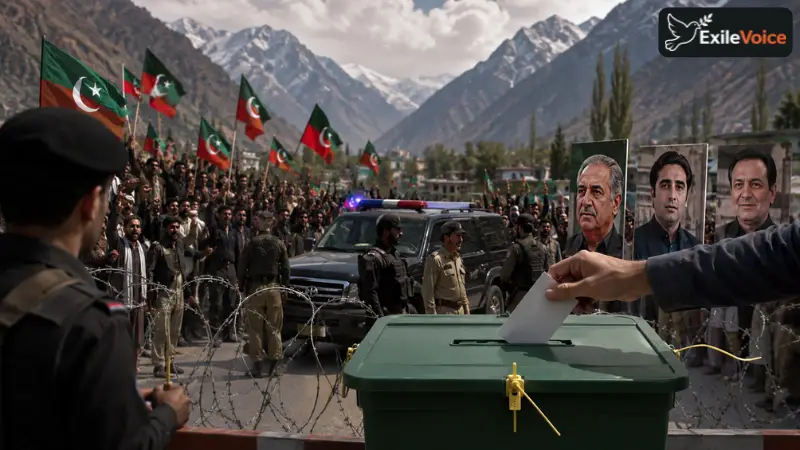
The upcoming regional elections in Gilgit-Baltistan, scheduled for June 7, have pushed the strategic northern territory into an intense political crisis. While the Pakistan Tehreek-e-Insaf (PTI) has staged massive, energized rallies across the valleys, demonstrating a substantial ground swell of public support, its leadership faces systematic obstacles. Observers and political analysts have raised alarms regarding widespread pre-election rigging tactics designed to suppress opposition activities and tilt the playing field.
The crisis deepened following highly coordinated state actions preventing prominent opposition figures from participating in the electoral process. Former National Assembly Speaker Asad Qaiser, a senior PTI leader, was barred from traveling to Gilgit-Baltistan to lead campaign rallies. In an unusual deployment of jurisdiction, Punjab Police established road blocks in Islamabad to intercept his delegation, despite the fact that his destination lay entirely outside the province of Punjab. This move coincided with the arrest of another key leader, Junaid Akbar, confirming what opposition leaders call a complete denial of political space.
Compounding the controversy, local administrative machinery has granted full state protocol and security access to competing parties, including leaders from the Pakistan Muslim League-Nawaz (PML-N) and Pakistan Peoples Party (PPP) Chairman Bilawal Bhutto Zardari. This clear disparity led Khyber Pakhtunkhwa Chief Minister Ali Amin Gandapur to formally write to the Chief Justice of the Supreme Appellate Court of Gilgit-Baltistan and the Chief Justice of Pakistan. The official communication requested urgent judicial intervention to stop administrative harassment and guarantee free, fair, and transparent elections.
Taimur Saleem Jhagra, a senior PTI leader, remarked that these aggressive state actions reflect the ongoing vulnerability of opposition forces following the events of February 8. He emphasized that while the public sentiment remains strongly aligned with imprisoned leader Imran Khan, the party's internal fragmentation has allowed the ruling establishment to exploit its divisions. As the region approaches the June 7 vote, the aggressive suppression of one political faction risks completely undermining the democratic legitimacy of the local assembly.

