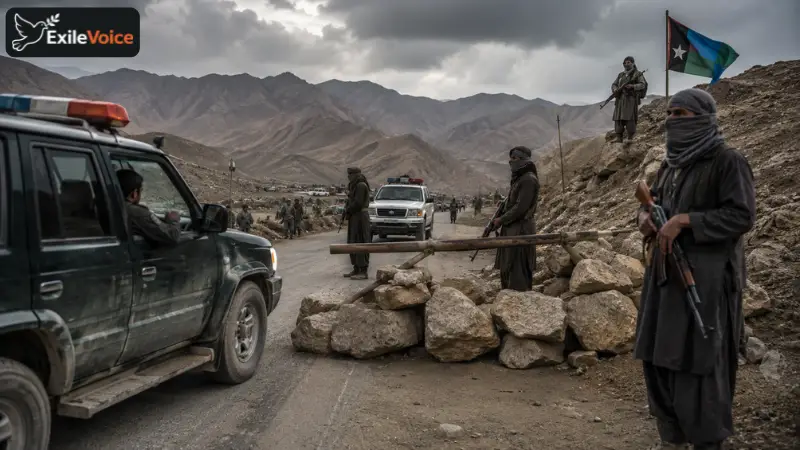
The internal security landscape of Balochistan has transformed from a low-intensity conflict into an institutional crisis where the authority of the state is visibly collapsing. Recent ground evidence reveals a highly troubling operational reality: armed separatists belonging to the Baloch Liberation Army (BLA) have established open checkpoint grids and strategic blockades across significant transit paths within the province. These areas function as operational non-governed spaces where sovereign authority is actively overridden.
The security crisis is starkly illustrated by a documented incident involving an active Balochistan Police vehicle encountering an unauthorized separatist checkpoint. Rather than engaging or asserting sovereign control, the state vehicle bypassed the checkpoint without questioning the legitimacy of the armed blockades or checking the registration of those challenging federal authority. This dynamic indicates that local security forces are operating within separatist-dominated corridors under an unwritten arrangement of passive coexistence. The police, tasked with preserving federal law, are instead adapting to the territorial boundaries established by non-state actors to maintain their own administrative survival.
The socioeconomic consequences of this administrative failure are severe. Balochistan has increasingly become a prohibited area for incoming professional classes and public sector workers from other provinces. The targeted abductions of academic administrators, including senior leadership from Gwadar University, alongside targeted executions of security personnel and civil administrators, demonstrate a coordinated strategy to disconnect the region from federal administrative frameworks. Civil authorities, ranging from Assistant Commissioners to Deputy Commissioners, face extreme security vulnerabilities, which limits the operational functionality of the provincial civil service. This security breakdown stems directly from long-term systemic failures in governance. For over four decades, Balochistan has been managed through indirect civil-military control. The political administration, currently led by Chief Minister Sarfraz Bugti under a Pakistan Peoples Party (PPP) banner, operates primarily as an institutional front. While civil political frameworks are utilized to project constitutional legitimacy, primary policy formulation and security management remain centralized within regional military structures. This dual-layered administrative architecture detaches political responsibility from actual executive power, undermining local governance and allowing armed insurgencies to expand unchecked.