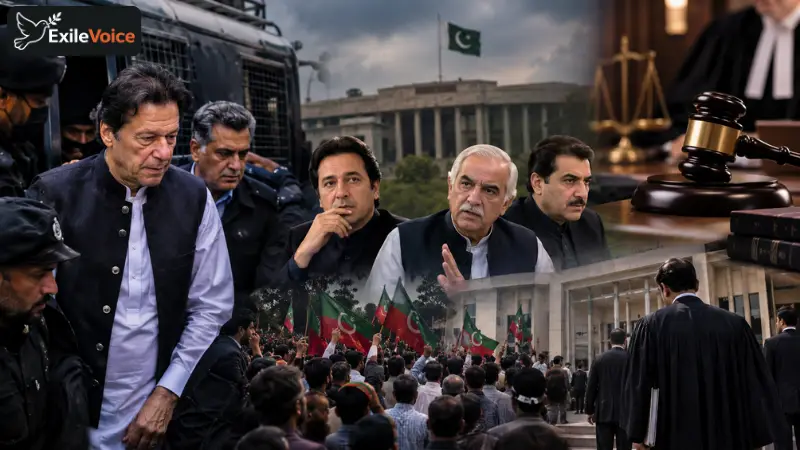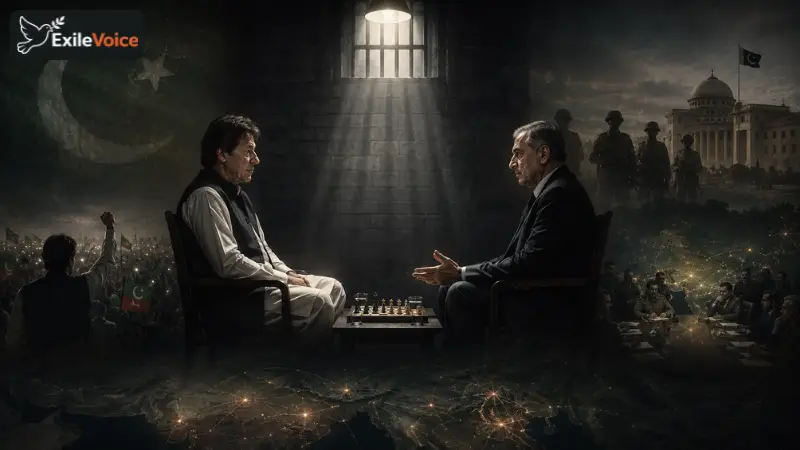
Reports regarding a high-stakes, unpublicized meeting inside Rawalpindi's Adiala Jail have ignited a whirlwind of analysis within Pakistan's volatile political and media landscapes. According to details broken by seasoned political journalists, former Prime Minister Imran Khan allegedly engaged in a detailed discussion spanning over an hour with a prominent retired Army Chief. The nature of this meeting, orchestrated with the implicit consent and institutional facilitation of the current military establishment, underscores the enduring complexity of the country's civil-military matrix and points toward a deliberate attempt to test the waters for future reconciliation or tactical adjustment.
Analysts dissecting the mechanics of the disclosure observe that the narrative was introduced into the public sphere with a high degree of journalistic confidence, indicating a calculated leak originating from within institutional sources rather than an accidental discovery. By narrowing down the specific parameters of the retired general, notably a figure who had previously secured a service extension and permanently resides within Pakistan, observers have increasingly focused on the potential intermediary role of retired General Ashfaq Parvez Kayani, as opposed to other contemporary military leaders who remain heavily polarized figures in the ongoing political discourse.
The structural necessity of such backchannel dialogue becomes clearer when examining the multifaceted crises currently confronting Pakistan's de facto governance framework. The nation faces mounting international commitments, persistent economic vulnerability under tight global lending programs, and an increasingly fractured internal political mandate. Historically, when institutional frameworks encounter structural gridlock, neutral intermediaries from past leadership eras are utilized to establish baseline terms of engagement. In this instance, the strategic calculation revolves around exploring how the immense public capital of Imran Khan can be leveraged or managed to ensure broader state stability, particularly in the event of major geopolitical changes on the global stage.
Furthermore, military and political strategists routinely develop complex war games and multi-tiered scenarios to safeguard institutional interests against unpredictable external shocks, such as shifts in United States foreign policy under a new presidential administration. If upcoming global realignments pressure the state to adopt sensitive geopolitical positions, the establishment recognizes that a fragmented, low-legitimacy civilian setup cannot absorb the domestic political fallout alone. Consequently, establishing a functional channel of communication with the country's most popular political entity becomes an essential contingency plan, allowing the state to maintain flexibility regardless of whether a formal settlement is ultimately reached.
While the exact operational details and immediate outcomes of the prison meeting remain closely guarded, the strategic implications are profound. It demonstrates that despite aggressive public rhetoric and overt legal constraints, the underlying institutional dynamics of Pakistan remain fundamentally pragmatic. When structural pressures reach a critical threshold, the necessity for political survival and systemic stability invariably reopens doors that appeared permanently closed, shifting the conversation from total exclusion to structured negotiation.