

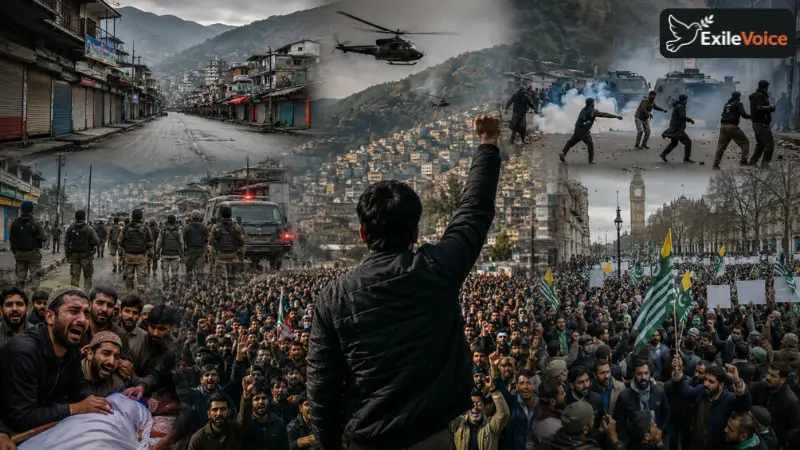
The geopolitical landscape of Pakistani-administered Azad Jammu and Kashmir (AJK) is undergoing a structural shift. Recent developments on the ground point to a massive, highly synchronized civil movement led by the Jammu Kashmir Joint Public Action Committee (JAAC). What began as grassroots public resistance against rising inflation, exorbitant electricity tariffs, and food shortages has evolved into a full-blown political crisis that is challenging both the local administration and federal oversight mechanisms.
According to verified field reporting, a complete shutter-down strike has paralyzed main commercial hubs, particularly in Muzaffarabad and Rawalakot. While public offices remain technically open, employee attendance is reportedly negligible, and major retail centers are entirely sealed. This state of near-total commercial standstill highlights the powerful influence of local committees over public behavior, rendering official declarations and administrative bans ineffective.
The situation has been further compounded by reports of structural security escalations. Eyewitness accounts and localized statements from political organizers note distinct tactical movements, including low-altitude helicopter operations around Muzaffarabad and the deployment of plainclothes personnel across sensitive transit corridors like Kotli. These movements have intensified fears of deep-state interference and potential false-flag operations designed to discredit the civilian nature of the protests.
The human toll of these escalations is already manifesting in violent clashes. In Kotli, fatal skirmishes have claimed the lives of both law enforcement relatives and local civilians. Simultaneously, serious transparency concerns have emerged regarding the state's handling of casualties, with reports alleging that the remains of multiple protesters were interred by state authorities without being properly returned to their families. This lack of transparency risks driving public resentment deeper, threatening to alienate a population that has historically aligned its core geopolitical stance with the narrative of the Pakistani state.
The domestic fallout is mirroring an international response. British-Kashmiri diaspora communities in major centers such as Luton and London have mobilized substantial public demonstrations. These communities, which previously focused their advocacy efforts outside foreign embassies to protest Indian policy in the region, have pivoted their focus toward the human rights situation and economic management within Pakistani-controlled areas. This shift damages the state’s external narrative and puts immense pressure on diplomatic channels.
The official responses from federal authorities reveal an inconsistent strategy. Key political figures have oscillated rapidly between proposing conditional dialogue and enforcing absolute administrative crackdowns, reflecting a fragmented internal policy. Meanwhile, state-aligned media elements have begun framing the civil action committees as existential threats to public order, a rhetorical escalation that typically precedes a heavy-handed security sweep. If the federal leadership continues to prioritize temporary tactical suppression over structural economic relief and transparent governance, the current civil unrest could transform into a permanent, unmanageable crisis along this critical geopolitical fault line.

