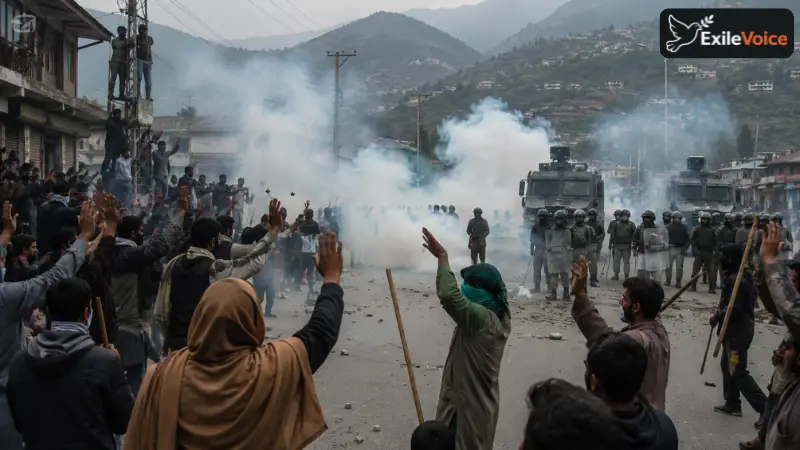
The geopolitical landscape of Azad Jammu and Kashmir (AJK) has taken a volatile turn as mass protests paralyze key cities, culminating in severe clashes between civilian demonstrators and security personnel. Reports emerging from Rawalakot indicate an intense escalation during the early hours, where security forces deployed heavy tear gas shelling and live ammunition against non-violent assembly crowds. The unfolding crisis represents a dangerous flashpoint for regional stability, highlighting deep-seated systemic tensions between local populations and federal administrative frameworks.
According to ground observers and digital investigative journalists, an estimated 150,000 to 200,000 protesters converged on the outskirts of Rawalakot. Local administration, led by Commissioner Waheed Khan, implemented a strict curfew within the urban core and sealed major transit corridors connecting Poonch and Rawalakot to the capital city of Muzaffarabad. Despite these containment strategies, thousands of peaceful demonstrators gathered in the local Eidgah ground, where power blackouts preceded sudden law enforcement interventions. Reports indicate multiple civilian casualties from direct gunfire, creating a highly provocative security environment that threatens to spill over into broader territories, including Bagh and surrounding valleys.
The standard operational playbook deployed by state institutions in these regions has drawn severe domestic criticism. Analogies are increasingly being drawn to historic governance failures where kinetic force was prioritized over political reconciliation. The state media apparatus, particularly the Pakistan Television Corporation (PTV), has continuously broadcast counter-narratives claiming that strike actions have failed and daily life remains completely normalized. This informational asymmetry mirrors historical precedents, such as the media management strategies of 1971, raising deep structural concerns regarding institutional transparency and the suppression of authentic civic grievances.
Compounding the political fallout, prominent Kashmiri leadership from across the Line of Control (LoC) has intervened rhetorically. Mirwaiz Umar Farooq, a veteran political figure, issued a statement expressing profound anxiety over the loss of civilian and law enforcement lives in AJK. He noted that when public assemblies scale to hundreds of thousands, it serves as an undeniable structural signal that state institutions have failed to listen. Kinetic crackdowns, arbitrary detentions, and administrative arrogance fail to resolve structural socio-economic grievances, instead radicalizing moderate factions and shifting the public discourse from demands for economic relief to outright institutional rejection.
Local trade bodies and civil society coalitions have established firm preconditions before engaging in any state-sponsored mediation. The Joint Awami Action Committee has demanded the immediate reversal of notifications outlawing civic groups, the complete withdrawal of paramilitary forces including the Frontier Constabulary (FC) and Pakistan Rangers, and accountability for deceased protesters. Demonstrating the internal discipline of the movement, local merchants recently expelled standard pro-government trade representatives who attempted to dilute the protest narrative on state television. As the stand-off intensifies, the lack of institutional flexibility risks turning local socio-economic demands into an unmanageable crisis of state legitimacy.