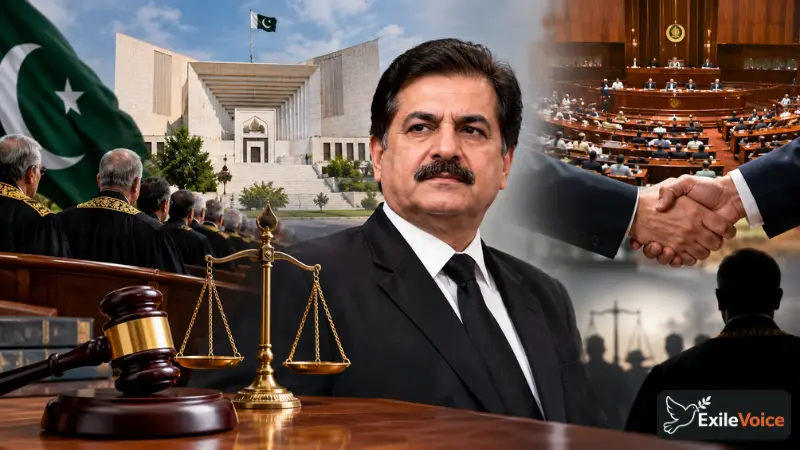
The judicial landscape in Pakistan stands at a critical juncture as political dynamics and constitutional amendments reshape the traditional mechanics of judicial elevation. Recent political commentary surrounding senior legal figures, particularly Ahsen Bhoon, has brought intense scrutiny to the future leadership of the Supreme Court of Pakistan. Discussions regarding high-profile judicial appointments reflect broader concerns regarding judicial independence, institutional autonomy, and the growing interplay between executive political maneuvering and the constitutional benchmark of the judiciary.
Historically, the elevation of the Chief Justice of Pakistan (CJP) adhered strictly to the seniority principle, where the most senior judge of the Supreme Court automatically assumed the office upon the retirement of the incumbent CJP. However, legislative shifts and structural revisions through landmark constitutional amendments have fundamentally altered this process. The introduction of parliamentary oversight committees and modified elevation criteria has created a framework where executive preferences, political alignment, and legal consensus carry significant weight in deciding who presides over the highest court in the land.
Ahsen Bhoon, a prominent figure within the Pakistan Bar Council (PBC) and former President of the Supreme Court Bar Association (SCBA), represents a key legal faction whose influence spans across judicial politics and executive policy. Proponents of his prospective judicial elevation point to his long-standing role in bar politics, his legal background, and his administrative capability in organizing legal professional bodies. However, analysts note that any non-traditional elevation or political backing raises fundamental questions about judicial neutrality.
Critics argue that altering traditional seniority mechanisms in favor of politically endorsed appointments risks compromising the perception of impartial justice. When senior legal professionals or judges are evaluated through a lens of political utility rather than pure constitutional precedent, the independence of the bench faces existential challenges. The legal community remains divided: one faction views parliamentary involvement in appointments as a necessary Democratic check on judicial overreach, while another perceives it as an executive effort to curtail an independent judiciary.
Furthermore, judicial appointments in Pakistan do not occur in a vacuum. They heavily influence ongoing political disputes, election litigation, executive accountability cases, and civil liberties protections. A Supreme Court bench led by figures perceived to be aligned with particular political coalitions risks heightened scrutiny from opposition parties, international legal observers, and civil society. To maintain institutional integrity, any future Chief Justice must demonstrate unwavering commitment to upholding constitutional principles above political considerations.
As Pakistan navigates complex socio-economic and political challenges, the stability of its judicial branch remains essential. Whether legal reforms lead to the elevation of seasoned bar leaders like Ahsen Bhoon or reinforce strict judicial seniority, the ultimate standard of success lies in preserving public trust, protecting fundamental rights, and upholding the rule of law without political fear or favor.