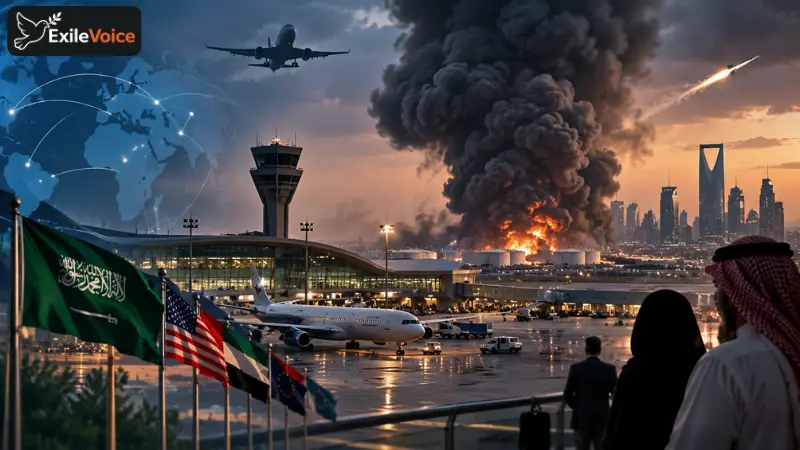
Saudi Arabia is facing a major escalation in regional security threats following a series of Houthi attacks targeting southern parts of the kingdom and critical energy infrastructure. The latest violence has raised concerns about the security of Saudi territory, the future of the Yemen conflict and the potential impact on global oil supplies and maritime trade.
The escalation is particularly significant because the attacks have moved beyond isolated military targets and have affected locations connected to Saudi Arabia's energy and economic infrastructure. Recent attacks involved drones and ballistic missiles, with Saudi authorities reporting dozens of injuries and disruptions at energy facilities. Reuters reported that 73 people were wounded in one major assault, while fires were reported at several facilities.
The strategic significance of the attacks extends well beyond Saudi Arabia's borders. The kingdom is one of the world's most important oil producers, meaning any sustained threat to its production, processing or transportation infrastructure can immediately influence international energy markets. The latest escalation has already contributed to a sharp rise in oil prices, with Brent crude moving above $100 a barrel amid concerns over further disruption.
The situation has become even more serious because the conflict is expanding around key maritime routes. Houthi forces have reportedly seized the Yemeni port of Mocha, located close to the Bab el-Mandeb Strait. This waterway is one of the world's most important maritime chokepoints, linking the Red Sea with the Gulf of Aden. Any prolonged disruption in this area could increase shipping costs, extend delivery routes and place additional pressure on global energy markets.
The renewed escalation also represents a major challenge for Saudi security policy. Riyadh must respond to attacks against its territory while avoiding actions that could trigger a much wider regional confrontation. Saudi Arabia has sought greater international support as the attacks have intensified, while the United States has so far shown reluctance to enter another direct military confrontation with the Houthis. Reuters reported that President Donald Trump declined a request from Saudi Crown Prince Mohammed bin Salman for direct US strikes against Houthi targets.
Pakistan has an especially delicate position in this crisis. Islamabad maintains a longstanding strategic relationship with Saudi Arabia and has recently deepened security cooperation with Riyadh and Ankara. At the same time, Pakistan shares important diplomatic and economic interests with Iran and has attempted to position itself as a channel for regional de-escalation.
Pakistan has already condemned the Houthi attacks against Saudi civilian and energy facilities. Prime Minister Shehbaz Sharif reaffirmed Pakistan's support for Saudi Arabia's sovereignty, security and territorial integrity following the attacks.
At the diplomatic level, Pakistan has also communicated a Saudi warning to Iran concerning the activities of the Iran-aligned Houthi movement. The development demonstrates the increasingly complicated role Islamabad is being asked to play. Pakistan wants to support Saudi security while avoiding direct military involvement in a conflict that could expand across the region.
The Makkah defense arrangement adds another layer of complexity. Pakistan has clarified that no immediate military response against the Houthis is currently under discussion under the defense pact. The Foreign Ministry has nevertheless reaffirmed Pakistan's commitment to the agreement and indicated that Islamabad would respond according to the circumstances if the situation develops further.
For Pakistan, the economic consequences of a prolonged regional conflict could be substantial even without direct military participation. Pakistan relies heavily on imported energy, and higher global oil prices can increase transportation costs, inflationary pressures and the country's import bill. Disruptions to maritime trade can also affect supply chains and shipping insurance costs.
The conflict therefore presents Pakistan with a difficult strategic calculation. Strong support for Saudi Arabia is important because of bilateral security and economic ties, but direct military involvement could expose Pakistan to additional security and financial risks. A diplomatic role may offer Islamabad an opportunity to protect its interests while encouraging de-escalation.
The wider international concern is that the conflict could develop into a broader confrontation involving Saudi Arabia, Iran, Yemen-based Houthi forces, the United States and other regional actors. Control of maritime chokepoints makes the situation particularly dangerous because disruptions could affect countries far beyond the immediate conflict zone.
The current crisis demonstrates how regional military developments can rapidly become global economic problems. An attack on an oil facility or a strategic port is no longer simply a local security incident. It can influence energy prices, shipping routes, insurance costs, inflation and diplomatic calculations across multiple continents.
For Saudi Arabia, protecting critical energy infrastructure and maritime routes will remain a central security priority. For Pakistan, maintaining diplomatic flexibility while honoring its strategic commitments will be equally important. The coming weeks could determine whether the current escalation remains contained or develops into a much broader regional crisis.