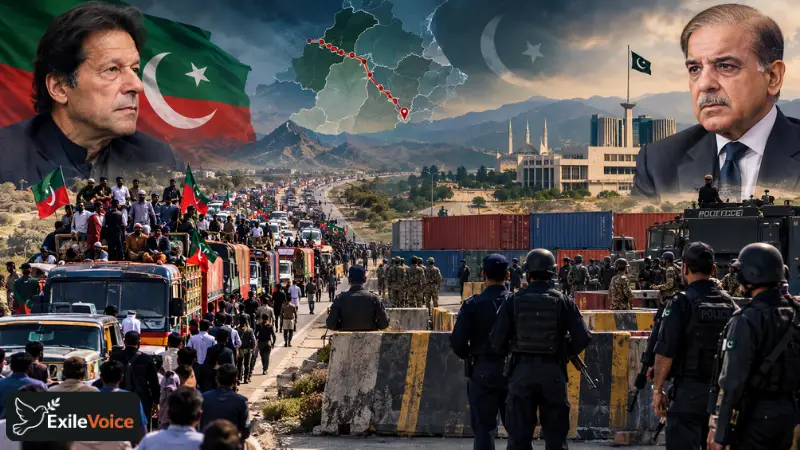
The resumption of the Pakistan Tehreek-e-Insaf (PTI) long march from Khyber Pakhtunkhwa toward Islamabad has triggered an extensive security mobilization and political confrontation across northern Pakistan. Led by Khyber Pakhtunkhwa Chief Minister Sohail Afridi, the protest convoy has traversed major southern and central districts, including Dera Ismail Khan, Lakki Marwat, Karak, and Kohat, heading toward the critical border checkpoint at Attock. This march represents a major test of administrative control, military-civilian security coordination, and political resilience.
At the core of the conflict is a fundamental dispute over state authority and public gathering rights. The federal government, operating through the Interior Ministry and provincial administration in Punjab, has deployed heavy security contingents, blocked key transit arteries with shipping containers, and enforced Section 144 across multiple jurisdictions. Federal officials argue that unauthorized public marches toward the capital threaten national security, disrupt economic activity, and undermine ongoing counter-terrorism operations in vulnerable regions.
Conversely, PTI leadership frames the long march as an exercise of fundamental democratic rights, demanding the release of party founder Imran Khan, the restoration of constitutional norms, and an immediate end to alleged political persecution. Chief Minister Sohail Afridi's direct involvement as the head of a provincial government leading a protest march against the federal center creates an unprecedented constitutional paradox. For the federal government, the use of provincial state machinery, helicopters, and government logistics to support political mobilization is viewed as a direct violation of constitutional oaths.
The security strategy deployed by federal authorities rests on a multi-layered containment model. The first line of defense is established at border points such as Khairabad and the Attock Bridge, where Punjab Police, Frontier Constabulary, and paramilitary forces are positioned to block progress into Punjab. Governor Faisal Karim Kundi has explicitly stated that the march will not be permitted to cross beyond Attock, highlighting the federal resolve to prevent any breach into the capital city.
Behind the security deployments lies a complex negotiation framework that repeatedly collapses due to entrenched distrust. While intermediate talks between government representatives and opposition figures occasionally yield short-term understandings regarding medical access or meeting permissions for incarcerated leaders, core political demands remain unaddressed. The federal side demands a complete cessation of road blockades and an explicit adherence to national security policies, whereas opposition organizers insist on immediate political concessions as a precondition for halting the march.
Military and intelligence assessments heavily influence these operational decisions. With security forces actively engaged in counter-insurgency operations across Khyber Pakhtunkhwa and Balochistan, internal political friction absorbs significant state capacity and intelligence resources. Analysts note that prolonged street friction dilutes focus from core security objectives, heightening risks of opportunistic insurgent activity in peripheral districts.
As the convoy halts at scheduled transit nodes along the Indus Highway, the immediate future hinges on whether political leadership can establish a sustainable dialogue mechanism. Should containment strategies lead to direct physical confrontation at border bottlenecks, the resulting fallout will accelerate political polarization and increase the likelihood of extreme constitutional measures by the federal center.