
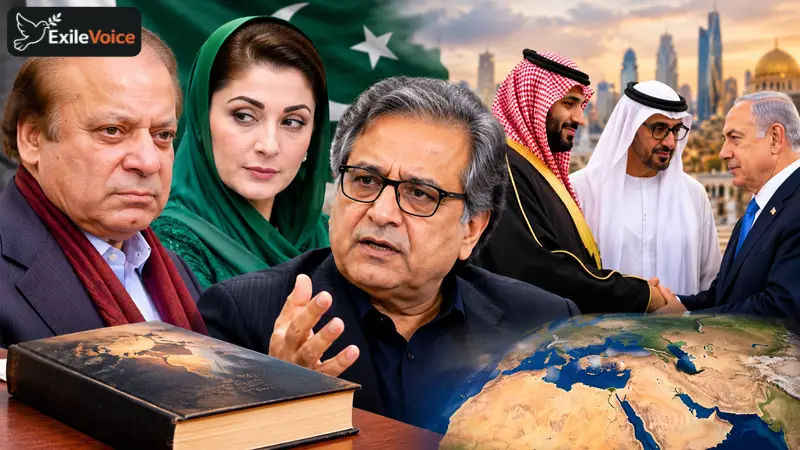
Recent commentary by Anek Naji, son of late senior journalist Nazir Naji and a figure long associated with close personal proximity to Nawaz Sharif and Maryam Nawaz in London, has stirred renewed debate over backroom politics and personal dynamics within the Sharif circle. Drawing on his long-standing familiarity with the family, Naji has made a series of pointed remarks regarding household routines, travel habits, and internal relationships, while also walking back or clarifying earlier statements after they sparked speculation online.
One focal point of Naji's remarks has been his clarification regarding an earlier reference to a heavy-set woman close to Nawaz Sharif. After social media users circulated AI-generated images and speculated about a woman residing in the United Kingdom, Naji stated that the woman he had in mind is not a UK resident but lives in Pakistan, is a member of parliament, and travels quietly to London around Nawaz Sharif's visits before departing. He also described her exercising domestic authority over household arrangements during visits to London, while declining to name her out of consideration for her family. In addition, Naji recounted an earlier exchange in a vehicle with Maryam Nawaz in which she spoke of having a direct line of reporting to the army chief, prompting him to question whether that direct channel remains unchanged.
Alongside these domestic and political accounts, attention has turned to investigative journalist Matthew Cole's book Princes and Thieves, which examines power struggles, political transitions, and geopolitical rivalries across the Middle East. Rather than reducing regional developments to simple external narratives, analysis of the book highlights how domestic ambitions, leadership succession, and alliances involving states such as Saudi Arabia, the United Arab Emirates, and Israel have shaped political outcomes in countries like Libya, Egypt, and Yemen.
For readers in Pakistan following questions of political realignment and outside influence, examining how elite rivalries and regional alignments operate in practice offers useful historical context. Understanding complex geopolitical shifts requires looking beyond surface slogans and examining the strategic interests and internal dynamics that drive major political transitions across the region.