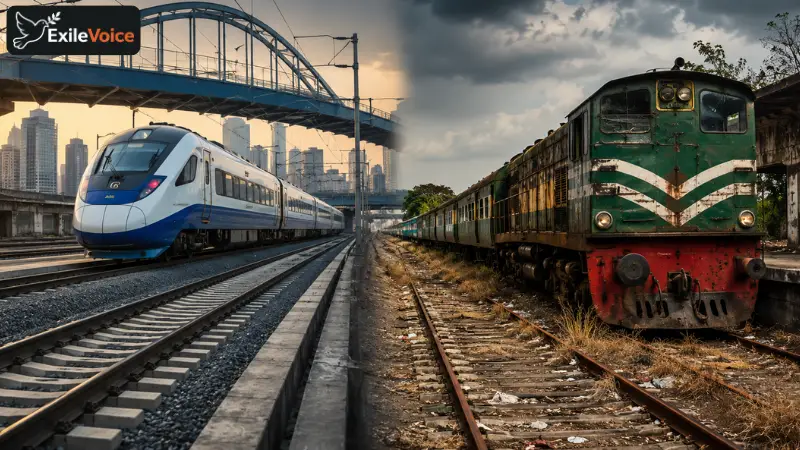
The historical trajectory of railway infrastructure in South Asia provides critical insight into the long term socio-economic and infrastructural divergence between India and Pakistan. Following the partition in 1947, assets were divided under agreed frameworks between the newly formed states. At inception, the Indian railway network inherited approximately 53,000 kilometers of tracks, whereas the Pakistani network received roughly 11,133 kilometers. Over the subsequent decades, divergent governance, investment strategies, and administrative priorities led to starkly different developmental outcomes for both systems.
In contemporary terms, Indian Railways has significantly expanded its asset base, extending its track network to over 69,181 kilometers. This expansion reflects a continuous process of modernization, network augmentation, and electrification. Reports indicate that a substantial majority of the expanded Indian network, approximately 90 percent, has undergone electrical traction conversion, facilitating modern digital signaling and operational efficiency. Furthermore, locomotive capacity and passenger coach availability witnessed steady growth, with engine counts and coach numbers scaling upward to meet rising passenger and freight demands.
Conversely, the infrastructure metrics in Pakistan reflect a period of stagnation and contraction. The operational track length decreased from its initial allocation to approximately 7,791 kilometers. Similarly, available locomotive engines and passenger coaches experienced reductions, with current active units falling significantly below historical figures. Analysts attribute these disparities to systemic governance challenges, financial constraints, and inconsistencies in institutional oversight. Incidents involving track compromises and operational disruptions underscore the pressing need for structural rehabilitation, transparent resource allocation, and long term strategic planning to revitalize public transport corridors and ensure commuter safety.