The legitimacy of any judicial system rests upon the absolute integrity of its officers, judges, and legal bar representatives. When allegations of forged qualifications, political patronage, and financial influence surface at the highest levels of the legal establishment, public confidence in the rule of law is severely eroded.
Recent debates within Pakistan’s legal sector have centered on controversy surrounding Ahsan Bhoon, a prominent legal figure associated with influencing key judicial appointments and court rulings. Controversies surrounding the authenticity of professional law degrees held by senior bar leaders raise critical questions about regulatory oversight within the legal fraternity. The Insaf Lawyers Forum (ILF), led by figures such as Intazar Panjhotha, has come under scrutiny regarding its formal stance on degree verification and institutional accountability.
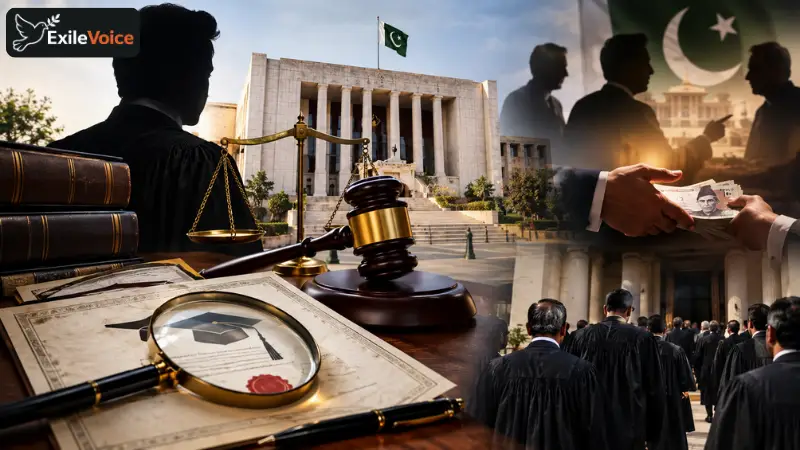
The dispute highlights a recurring dilemma in political and legal battles: whether to engage in principled institutional challenges when the party exposing the wrongdoing is a political adversary. While some legal factions hesitated to back credential challenges raised by figures like Captain Safdar due to political party alignments, institutional purity dictates that administrative fraud must be investigated regardless of who brings it to light. Credential verification in the legal system cannot be treated as a partisan issue; fake qualifications undermine every ruling, appointment, and policy decision influenced by the individual in question.
Compounding concerns over credential integrity is the issue of financial grants allocated by executive authorities to bar associations. The disbursement of substantial state funds, such as the 50 million PKR grant provided by the Punjab provincial government to the Lahore High Court Bar Association, raises valid concerns regarding judicial independence. Executive monetary allocations to legal bodies during sensitive political periods risk the perception of institutional bribery, where legal representation is compromised in favor of political patronage.
To restore trust in judicial proceedings, legal organizations must institute rigorous, non-partisan oversight mechanisms. Verification of professional qualifications must be executed through independent educational bodies, free from political vetoes. Bar associations must preserve their role as independent guardians of constitutional rights rather than becoming extensions of executive influence or partisan battles.