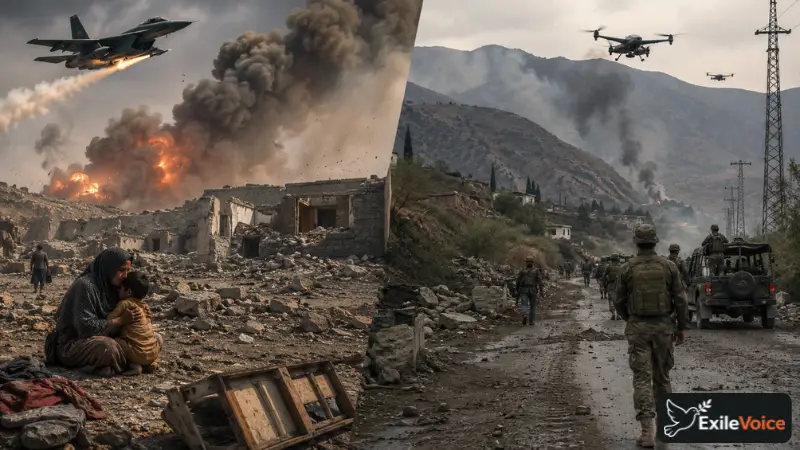
The security landscape in Pakistan has reached a critical juncture, marked by intense military operations in Balochistan and escalating instability in the Khyber Pakhtunkhwa (KP) region. Recent reports originating from the Sorab district in Balochistan suggest that Pakistani fighter jets have conducted strikes, resulting in significant loss of life, including women and children. These operations have left behind scenes that depict a war-torn environment, raising serious concerns regarding the scale and necessity of such actions.
Beyond aerial bombardments, the situation on the ground remains volatile. There are reports of trenches being dug in areas like Turbat, with conflicting claims regarding their origin. While groups like the Balochistan Liberation Army (BLA) claim responsibility for these excavations, security agencies offer their own interpretations. This ambiguity raises fundamental questions about the control of these regions, the efficacy of local law enforcement, and the presence of heavy machinery in areas that should be under state oversight. The inability to ensure basic security, combined with the destruction of infrastructure, has further alienated the local population and deepened the governance vacuum.
Simultaneously, the situation in Khyber Pakhtunkhwa, specifically in North Waziristan, mirrors this instability. The region has witnessed intense gunfire, reminiscent of frontline military engagements, accompanied by frequent drone strikes. Despite clear instructions from political leadership to register First Information Reports (FIRs) against those responsible for these attacks, implementation remains elusive. Attempts by citizens to seek legal recourse have often been met with suppression, highlighting a systemic failure in the rule of law. The lack of accountability for civilian casualties in these drone strikes, coupled with the systemic silencing of dissent, has fostered a sense of helplessness among the populace.
This duality of crises, one in the south and one in the northwest, suggests a deeper systemic failure. The state's response, characterized by heavy-handed military measures and a failure to address the underlying socio-political grievances, has arguably exacerbated the conflict rather than resolving it. The disconnect between official narratives and the lived reality of those in these regions remains a significant obstacle to stability. As the nation prepares for Independence Day, the contrast between the celebratory rhetoric and the grim reality on the ground, characterized by violence, lack of infrastructure, and a breakdown of civilian governance, presents a profound challenge to national cohesion.
The overarching concern is that these regions are effectively slipping out of the state’s functional control. The strategy employed by the current administration has yet to yield a peaceful resolution; instead, it has perpetuated a cycle of violence that continues to exact a heavy toll on innocent lives, ultimately threatening the long-term stability of the federation.