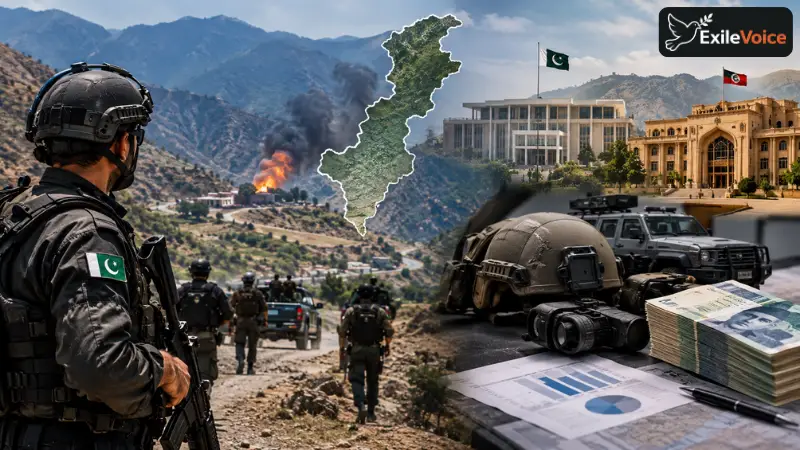
The security environment in Khyber Pakhtunkhwa (KP) has reached a critical juncture, marked by increasing frequency and severity of militant attacks. Recent incidents, including a double-tap attack in Dera Ismail Khan targeting a military post followed by incoming emergency response teams, highlight the changing tactics of armed groups operating in the region. The escalation has placed immense strain on provincial law enforcement agencies, front-line responders, and civilian populations, while reigniting fundamental debates over national counter-terrorism doctrine and inter-governmental security cooperation.
The provincial government of Khyber Pakhtunkhwa, led by Chief Minister Ali Amin Gandapur and regional leadership, has raised substantial concerns regarding the allocation and procurement of security apparatus. In response to rising threats, the provincial administration executed significant budgetary reallocations, redirecting approximately 35 billion PKR from provincial development programs toward law enforcement modernization. For the 2026–2027 fiscal year, the police operational budget was expanded to 191 billion PKR, representing a 103 percent increase designed to bolster personnel equipment, thermal vision gear, armored vehicles, and surveillance infrastructure.
Despite these internal reallocations, institutional friction between federal authorities and the provincial government has delayed the delivery of critical counter-terrorism equipment. Funding remitted by the provincial government to federal procurement channels, including Heavy Industries Taxila (HIT) and National Radio Telecommunication Corporation (NRTC), has experienced administrative hold-ups. While capital security units in Islamabad and other provinces continue to receive upgraded bulletproof vehicles and counter-drone systems, KP frontline units face severe supply constraints. This resource disparity has created substantial tactical challenges for local police, who bear the primary weight of casualties in frontline engagements.
The current security dynamic also raises questions regarding the long-term effectiveness of traditional kinetic operations. For over two decades, counter-insurgency doctrine in the region has relied on a kinetic framework often referred to as "Clear, Hold, Build." While designed to clear hostile entities and secure territorial control for development, critics argue that repeated kinetic interventions without sustained local governance and economic reintegration fail to yield permanent stability. In 2025 and 2026, casualty figures across Khyber Pakhtunkhwa and Balochistan surpassed historical benchmarks, indicating that existing operational frameworks require substantial adjustments.
The provincial leadership advocate for a structural policy shift embodied in a revamped Provincial Action Plan. This proposal emphasizes localized police empowerment, institutional autonomy, intelligence-led targeting, and transparent provincial governance over recurring military sweeps. However, political gridlock between the federal administration in Islamabad and the provincial assembly in Peshawar continues to hinder cohesive strategy execution. As counter-terrorism demands escalate, closing the gap in inter-governmental procurement and aligning national security doctrine with ground-level operational needs remain essential prerequisites for long-term regional stability.