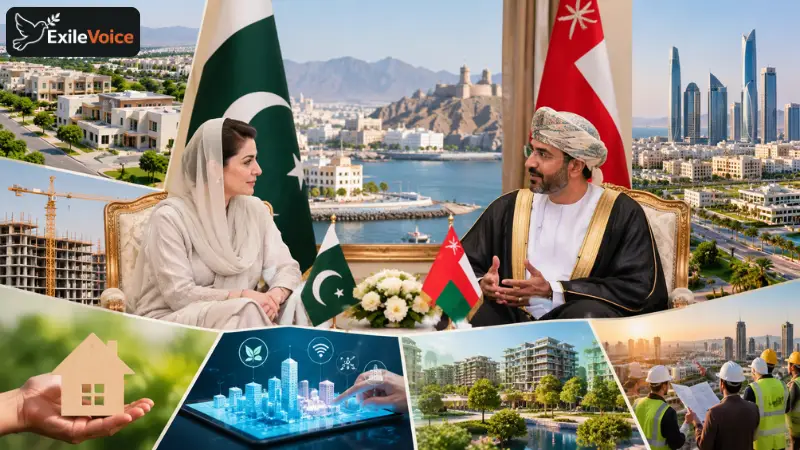
Following the presentation of the UN-Habitat Scroll of Honour in Muscat, Chief Minister Maryam Nawaz Sharif held a high-level bilateral conference with Oman’s Minister of Housing and Urban Planning, Dr. Khalfan bin Saeed Al Shueili. The meeting established a formal platform for knowledge exchange, real estate investment collaboration, and strategic urban development comparisons between Oman and the Province of Punjab.
During the dialogue, Dr. Khalfan commended Punjab’s "Apni Chhat, Apna Ghar" program, specifically noting that its interest-free financing model offers important insights even for established Gulf economies. While Oman currently maintains a dual-track housing system, offering direct housing grants for citizens earning below $1,000 alongside subsidized loans through the Oman Housing Bank, the Omani Minister highlighted Punjab’s digitized, zero-interest model as an exemplary model for reducing long-term public debt burdens while accelerating home ownership rates.
The conference also focused on sustainable urban growth and smart city infrastructure. Oman’s Ministry of Housing outlined Muscat’s current urban development strategy, which relies on two separate, specialized departments dedicated to housing delivery and urban planning. Muscat’s master plan prioritizes integrated, eco-friendly strategies designed to absorb rapid demographic growth while attracting private real estate investment. Dr. Khalfan stressed that future-proofed smart housing, community-centric planning, and environmental safeguards remain the cornerstones of Oman’s modern infrastructure investments.
A major focus of the talks centered on the contribution of the Pakistani diaspora and corporate sector in Oman. Omani officials lauded Pakistani companies and construction engineering firms for playing a vital, ongoing role in developing Muscat’s expanding real estate market. Dr. Khalfan noted that Oman continues to serve as an inviting destination for Pakistani skilled labor and business ventures, calling the relationship deep-rooted and mutually beneficial.
To capitalize on these synergies, both leaders agreed to explore formal avenues for knowledge transfer. Punjab intends to study Oman’s integrated urban zoning and smart infrastructure protocols, while Omani housing officials expressed keen interest in analyzing Punjab’s digital socio-economic mapping tools and interest-free micro-mortgage delivery systems. This dialogue marks a shift toward operational, sector-specific partnerships between South Asian regional governments and Gulf Cooperation Council (GCC) nations.