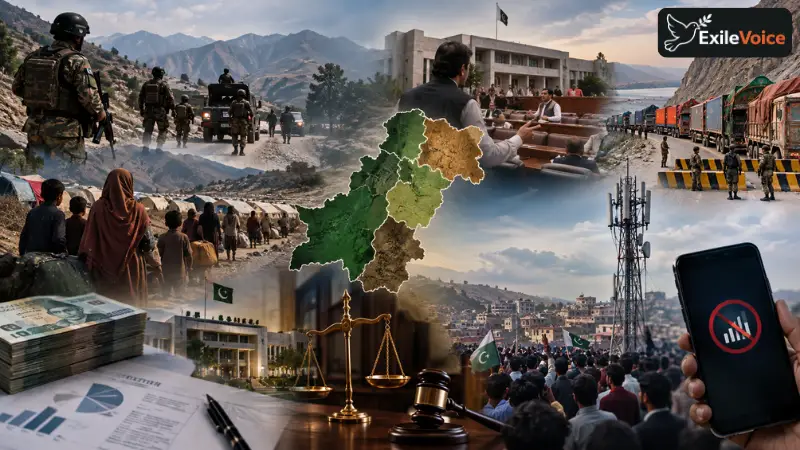
Security management and judicial administration across Pakistan's frontier regions, particularly Khyber Pakhtunkhwa (KP), Balochistan, and Azad Jammu & Kashmir (AJK), are facing acute pressure. As counter-terrorism operations escalate alongside local governance friction, fiscal allocations and civil rights concerns have emerged at the forefront of policy debates.
In Khyber Pakhtunkhwa, provincial fiscal records reveal substantial financial commitments toward law enforcement and judicial infrastructure. KP allocates roughly 9 percent of its annual budget to police operations, a ratio significantly higher than Punjab's allocation of approximately 3.6 percent. Furthermore, judicial development programs in KP exceed 6 billion PKR annually. Despite these heavy expenditures, local administrators face growing challenges stemming from population displacement due to security sweeps in districts such as Bajaur, Kurram, and North Waziristan, where tens of thousands of families require continuous temporary shelter and rehabilitation support.
Security operations have also generated friction between law enforcement authorities and local political representatives. Recent midnight raids on provincial lawmakers' residences in KP have drawn sharp condemnation from parliamentary leaders, who argue that institutional overreach undermines municipal cooperation in counter-terrorism efforts. Similar governance tensions have surfaced in Balochistan, where trade route disruptions near Turbat due to security incidents have hindered commercial transport and regional trade stability.
In Azad Jammu & Kashmir, public frustration over administrative enforcement and civic rights reached a flashpoint, prompting state authorities to impose temporary communications suspensions across major urban areas. Broader security measures and digital blockades have raised concerns among human rights observers regarding civic space, civil liberties, and the economic fallout for digital commerce. Addressing these multi-regional security challenges requires balancing firm counter-terrorism measures with transparent judicial governance, civil rights protection, and sustainable economic relief for impacted populations.