

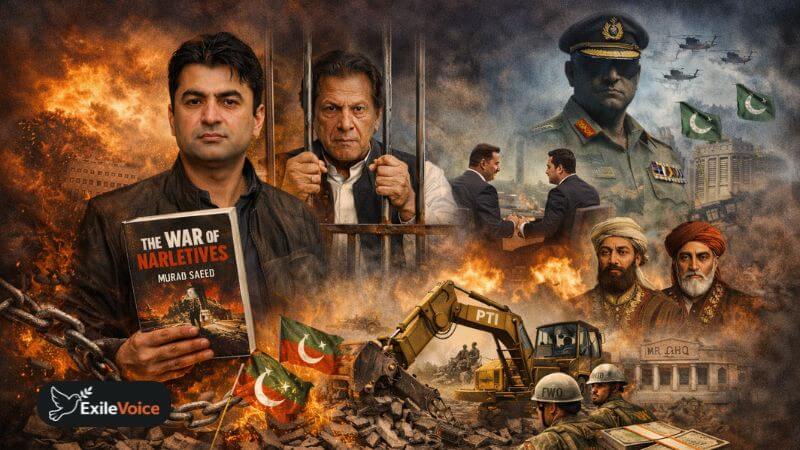
In the volatile theater of Pakistani politics, a new chapter has emerged with the release of a book attributed to Murad Saeed, a prominent leader of the Pakistan Tehreek-e-Insaf (PTI). This development is not merely a literary milestone but a significant maneuver in what Adil Raja describes as "Narrative Warfare." As the PTI ecosystem continues to navigate a landscape where its founding chairman, Imran Khan, remains incarcerated, the emergence of Murad Saeed’s perspective serves as a mirror to the power structures that define the state.
The Core Conflict: Owner vs. Manager
The video posits that the central friction in Pakistan is not about corruption or traditional policy disagreements, but about the fundamental nature of power. Adil Raja argues that for decades, the military establishment (often referred to as the "Engineers") has viewed the Prime Minister as a "manager" or "clerk" rather than an "owner."
Imran Khan’s "crime," in the eyes of the establishment, was his attempt to shift the command and control of the state toward civilian supremacy. By adopting an "owner mindset" and asserting authority over foreign policy and strategic decisions—exemplified by his famous "Absolutely Not" stance—Khan crossed a red line. This shift challenged the historical single-lane policy dictated by the GHQ, leading to an existential threat for the establishment.
The Exposure of the "Business Interest"
A striking revelation discussed in the video, citing Murad Saeed’s book, relates to the Frontier Works Organization (FWO) and the military’s involvement in commercial infrastructure. Saeed claims that PTI’s ability to build roads at nearly half the cost previously charged by military-run organizations exposed a massive discrepancy.
This exposure hit the establishment where it hurts most: the economy of the "Security State." When PTI began performing public works more efficiently and transparently, it threatened a network that benefits from state contracts without the burden of traditional taxation. This economic friction, Raja suggests, was a primary driver in the move to dismantle the PTI government.
The Role of "Turncoats" and Backstabbing
One of the most poignant themes of the analysis is the "controlled demolition" of PTI from within. Raja reflects on the historical use of "Mir Jafars and Mir Sadiqs"—individuals within the party who served as tools for the establishment.
The video criticizes figures like Fawad Chaudhry and others who abandoned the party during the crackdown. Raja highlights a "classic scene" in Pakistani politics: "The leader is in jail, and the turncoats are in the TV studios." He argues that while Imran Khan stands alone in his resistance, many of his hand-picked "Vaseem Akram Plus" appointments and financial backers fled at the first sign of pressure, seeking deals or simply acting as embedded representatives of the establishment.
Where is Murad Saeed?
Addressing the rumors surrounding Murad Saeed’s whereabouts, Raja provides specific insights. Despite claims that he might be in ISI custody, Raja asserts that Saeed has been in hiding, moving between Mianwali and Khyber Pakhtunkhwa.
Reportedly, Chief Minister Ali Amin Gandapur played a role in managing the situation, providing guarantees to the establishment to prevent active raids. Raja notes that while Saeed remains influential over certain factions in the KPK government, he is not under the control of the intelligence agencies. The very fact that his book is circulating—albeit through unconventional channels—suggests a continued attempt to resist the prevailing narrative.
Conclusion: A Post-Mortem of Power
The video concludes that the struggle in Pakistan is no longer about a single personality, but about a principle: the idea that the people are the ultimate source of power. However, Raja leaves the audience with a sobering reminder: revolutions do not come from tweets; they come from "defections" within the system.
As long as the establishment can isolate a leader by using internal "lotas" (turncoats) to sabotage the movement, the status quo remains. The "War of Narratives" continues, with the public caught between the populist appeal of a jailed leader and the institutional weight of a managed democracy.